AI, data privacy, and regulation, minus the noise.Get the insights that matter, straight from Limina.
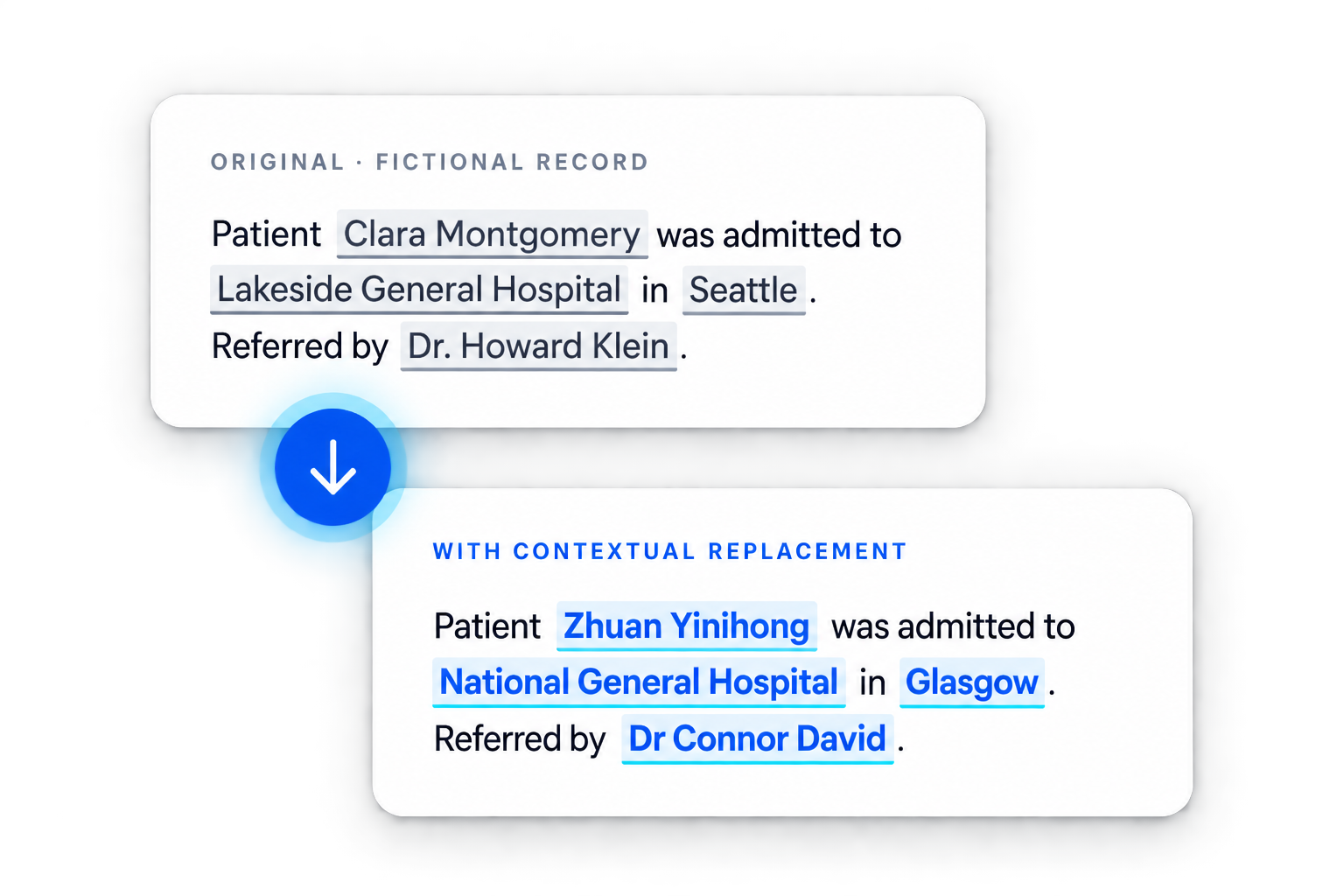
Redaction protects identity by destroying information. Limina's new Contextual Replacement capability takes a different approach, replacing sensitive identifiers with contextually accurate synthetic values so your data stays useful for research, collaboration and AI training.
New hybrid capability in release 4.5 replaces sensitive identifiers with contextually accurate synthetic values, keeping de-identified data useful for research, collaboration and AI training
Call transcripts and chat logs contain buried PII, PHI, and PCI data that rules-based tools miss. Learn how automated NLP redaction cleans conversational text, aligns audio timestamps, and ensures compliance with PCI DSS, HIPAA, and GDPR.
Training enterprise AI on raw text risks model memorization and PII extraction. Since unlearning weights is nearly impossible, pre-ingestion de-identification protects privacy, satisfies GDPR and HIPAA, and preserves key model utility.
PDFs often hide PII under black boxes, metadata, form fields, and scanned pages. Drawing boxes doesn't remove data. Learn how true automated PDF redaction strips hidden text, cleans layers, and ensures full HIPAA, GDPR, and CCPA compliance.
Emails represent the largest unstructured PII risk for enterprises, hiding data in bodies, headers, and attachments. Discover how automated NLP detection and redaction work at archive scale to ensure GDPR compliance and secure AI pipelines.
Unstructured PHI lives in clinical notes, emails, and recordings outside your EHR controls. Learn how natural language processing reliably detects and de-identifies protected health information across narrative text to ensure HIPAA compliance.
Unstructured data lacks a predefined schema, making sensitive PII and PHI hiding in emails, PDFs, and audio recordings hard to detect. Regulators treat this data like database records. Learn the key compliance risks and how to protect your files.
Training healthcare LLMs requires HIPAA-compliant de-identification of clinical narrative text to prevent data leaks. Pre-ingestion de-identification ensures compliance, satisfies FDA or IRB reviews, and prevents the model from memorizing PHI.
Privacy-preserving AI uses de-identification, differential privacy, federated learning, and synthetic data to train ML models safely. De-identification offers the best balance of data utility and strict compliance for enterprise machine learning.
AI models can permanently memorize and leak sensitive training data. This guide outlines critical data privacy risks—from inference attacks to compliance traps—and explains how early de-identification protects pipelines without ruining model utility.
Building a HIPAA-compliant AI pipeline requires stripping PHI early. This guide explores the two primary compliance pathways-de-identification versus data use agreements-and outlines a secure, six-stage architecture engineered for healthcare systems.
California SB 243 (effective 2026) regulates AI companion chatbots. It requires AI disclosures, minor safety protections, and crisis protocols for covered bots accessible in CA. Violations risk private lawsuits and heavy data compliance liabilities.
Deploying AI chatbots in regulated sectors means navigating a complex web of HIPAA, GDPR, and evolving state laws like California's CPRA and SB 243. Often, companies discover compliance risks only after a bot goes live and captures sensitive data.
HIPAA expert determination costs vary based on data complexity and intended use, ranging from a few thousand to tens of thousands of dollars. While Safe Harbor lacks upfront statistician fees, its blunt approach destroys clinical data utility. Investing in high-quality, upstream de-identification tooling is the best way to optimize these costs.